there is so much going on that i can't begin to go through it all.
happy first of march! exactly 2 months more until my no-fun adventure with hodgkin's lymphoma hopefully comes to an end. that alone is enough to make me want to jump up and down for the rest of my life. seriously.
my first book discussion on images of america: greeks in queens took place at the bayside historical society last friday (thankfully, time flies, especially during chemo week when you're stuck in a sleepy-haze). i had the best time and met a lot of great people. here's some photos...
it was quite fun. between events like this and friend-based fun about to happen, i couldn't be happier. it'd be great if chemo was over already!
really, chemo sucks cuz you want to end it as soon as possible and as a result, you stay home more. but i'm making plans to go (and be) out all the time come springtime.
it can't come fast enough.
so please, if you have any ideas of fun activities (new york based or otherwise, cuz we all know i am NOT staying home) please let me know. whosthatgamine@gmail.com
can't wait to catch up on your blogs now!!
Showing posts with label historian. Show all posts
3.01.2013
10.10.2012
life: twisty turny, part 1
it's no joke that october is always a crazy month for me.
it really, truly is.
after a wonderful bout of illness, antibiotics and medicine, i have [finally] gotten back to my old self!
first off, i've been booking appointments to doctors. all kinds. ugh. moving on.
timeline'd:
it really, truly is.
after a wonderful bout of illness, antibiotics and medicine, i have [finally] gotten back to my old self!
first off, i've been booking appointments to doctors. all kinds. ugh. moving on.
timeline'd:
- my book was released October 8th. Here's the facebook link here...it's been listed on
(the links should take you exactly to my book!)
- i'm doing a wholesale quote on 50 of my books if anyone wants to purchase them! e-mail me at whosthatgamine@gmail.com for details.
- i've booked author signings! another huge milestone for me- please check my facebook page for details.
- one of the most exciting things about this month is that we've celebrated our 12 years and one month dating anniversary/church-wedding anniversary.
- in december, we celebrate the fact that we got married 3 times before we turned 25! we like to think that it's a huge milestone and to celebrate again...
- we're going away at some point in december! that means some more crazy adventures with my soulmate.
- then, there's halloween based fun. isn't that enough?
- my 'book launch' is this weekend.
- we are shipping some book packages off to family and friends in Greece.
- i've been working on my other book ventures- children's books, fictional novels and historical/pictorials. basically, i'm working on my empire around the clock.
there are so many celebrations to be had, and so many things to do before we bring in 2013. I will definitely be posting and hope that you'll follow my craziness.
you're all awesome :)
love me,
the globetrotting gamine
10.06.2012
a church...
You can still see evidence of the fires :(
They commemorate people's memories in such beautiful ways. tomorrow, i'll post photos from the cemetery.
this place really stuck with me.
9.19.2012
people fear cemeteries...
i don't know why- i never did. My Grandfather passed away, God Rest his Soul, when I was 8 years old so I've spend a LOT of time in cemeteries. I think people fear the unknown, when the fear they should have is living an unfulfilled life.
The photo above was shot in Barbados, is completely untouched, and there's a lot of creepy colorful glares on it.
It's also one of the oldest tombs in the cemetery we'd visited.
The photo above was shot in Barbados, is completely untouched, and there's a lot of creepy colorful glares on it.
It's also one of the oldest tombs in the cemetery we'd visited.
8.24.2012
notes from this place
Planting
Fields opens its spring exhibition, Cocktail Culture:
The Gold Glamorous
Coast Years From Prohibition to 1960, March 31st at Coe Hall, open every day
11:30am – 3:30pm, through September 30th.
Coe Hall opens for
the season with the exciting Cocktail Culture exhibition that can be seen every
day, 11:30am – 3:30pm through September 30th. Starting with the 1920s, the show
is a veritable feast for the eyes and includes fabulous clothes by some of the
greatest designers of their time such as Mariano Fortuny and Elsa Schiaparelli.
There are extraordinary works of art for women's feet made by Salvatore
Ferragamo in the 1930s and by Dalman and I Miller. Also included are beautiful
hats by Tatiana of Saks 5th Ave and by Adrian of Hollywood.
The cocktail is the
consummate American medium, embodying a unique mixture of innovation, modernity
and glamour. As shown in the exhibition, its history in fashion, bar
accessories, and popular imagery, captures the spirit of an American
phenomenon. The exhibit begins at the time that Coe Hall was being built, in
1920, the same year in which the Prohibition Amendment became law (it was
repealed in 1933). For their new house at Planting Fields, Mr. and Mrs. William
Robertson Coe had a very large secret storage space built in the basement for
bottles of liquor. To this day there still is a massive safe door hidden behind
a nondescript board and batten door that might be found in any service area. It
is clear that the Coes did not want Prohibition enforcement agents to know that
they had seven hundred square feet of cellar with shelves for bottle storage.
In Mr. Coe's study, sometimes known as the den, the bar is also a hidden space,
its entrance door seemingly part of the room's Tudor style oak paneling. The
general ledgers originally maintained by Mr. Coe’s New York City office, and
now in the Foundation’s archives, reveal that in 1918 and 1919, the two years
leading up to Prohibition, Mr. Coe, whose favorite drink was the Manhattan –
made from whisky, was stockpiling liquor. In 1918 he spent $10,021.65 (today
about $143,834), in 1919, $25,328.07 (today about $316,376), for a grand total
of $35,349.72 (today over $441,000). Champagne and whiskey were the two most
stockpiled types of liquor. Other liquor purchases in 1918 and 1919 include
sherry, brandy, vermouth, and wine. It is hard to determine Mr. Coe’s usual
annual expenditure on alcohol because he only kept a separate entry for liquor
in 1918 and 1919; in previous years it was included in general household
expenses.
The new law made it
illegal to make or transport liquor, but Long Island became one of the most
notorious routes along which liquor was trucked from the island's many shore
towns, where it had arrived by boat, mostly from Canada and the Caribbean, and
then by road to New York City. Prohibition agents patrolled the highways ready
to confiscate illegal liquor. Twice in 1924 agents caught Mrs. Coe’s brother,
Henry Huddleston Rogers, having liquor shipped by his chauffeur from his Long
Island mansion to his apartment at the Ritz-Carlton Hotel in New York City.
Following the second incident in December 1924, Rogers’ attorney produced a
Federal Permit declaring the liquor transfers legal. The Volstead Act had a
loophole that allowed the transportation of alcohol from one permanent
residence to another provided a permit was obtained. During the same period of
time, speakeasies in the village of Oyster Bay were notorious, several of them
conveniently located near the waterfront. A letter to the Times in 1924 took
the police to task for permitting such “goings on” to continue. The subject of
cocktails is often a feature of novels of the period including F. Scott
Fitzgerald's 1925 The Great Gatsby, where at a party on the North Shore it is
observed that, "The bar is in full swing, and floating rounds of cocktails
permeate the garden outside...”
In the exhibition,
dresses from the 1920s reflect women's new freedoms, including the vote (1920);
the flappers' independence found expression in their new style un-corseted,
skin-revealing sheath dress. The shorter skirts drew attention to the legs and
the surfaces of dresses, which often had reflective beads, sequins and fringe,
further emphasizing the flappers contagious energy. Hollywood embraced cocktail
culture and the prototypical flapper. Films such as "Three Broadway
Girls" (1932) with its sassy gold diggers dressed by Chanel, showed its
stars in speakeasy bars at the height of Prohibition. Drink titles were
inspired by popular fast moving dances, including the Charleston Cocktail and
the Foxtrot Cocktail. Shoes in the 1920s reached an exceptional level of
craftsmanship, innovation and ornate Art Deco designs, several types of which
are included in the exhibition.
The repeal in 1933 of
the 18th Amendment that had banned alcoholic drinks, reinvigorated cocktail
culture. Innovative cocktail recipes, new forms of cocktail accessories, and
supper and nightclubs proliferated. The term "cocktail dress" entered
the fashion lexicon around 1935. With the ubiquitous little black dress a woman
would wear costume jewelry and could top off her ensemble with a whimsical hat
or fascinator. The typical 1930s silhouette was elongated and figure hugging,
in contrast to the earlier sheath. Like the dresses, cocktail shakers took on
the attenuated lines of the skyscraper aesthetic which was uniquely American.
Speakeasies became legal restaurants, such as The Stork Club and the 21 Club,
which still exists today and where Natalie Coe, the daughter of Mr. and Mrs.
Coe, was photographed at the bar in the early 1930s.
During World War II,
government restrictions on wool, silk, leather, and nylon, as well as on metal
buttons, pleating and full skirts had a sobering effect on fashions. The era's
military-inspired silhouette for women had padded shoulders, slim hips, and a
knee-length skirt better suited to practical wartime work. Paris was no longer
the epicenter of new fashion; therefore, American designers became more
inventive with designs for accessories, making fanciful shoes, hats, and gloves
which was an easy and economical way to embellish an outfit. At the same time
new materials, including plastics and synthetic fabrics, were used in
innovative ways. With the advent of food rationing, the cocktail party became a
convenient way to entertain without the pressure of providing a lavish spread
of food.
After the war there
was a return to the traditional and overtly feminine fashion silhouette. In
1947 Paris resumed its role as the center of couture with Christian Dior's
revolutionary New Look silhouette, featuring a wasp waist, padded hips, rounded
shoulders, and lavish full skirt; this was a huge change from the sobriety of
the war years. In regard to cocktails, gender-specific drinks became the rage;
for women, brightly colored drinks - the Pink Lady and the Brandy Flip. For men
cocktails were more restrained - the Manhattan, Old Fashioned, or Martini.
At Planting Fields
the cocktail era came to an end in 1955 with the death of Mr. Coe. His second
wife, Caroline, died in 1960. And so the exhibition ends with the traditional
ladylike cocktail ensembles with the requisite hat and gloves of the late
1950s, and with a glimpse of the quintessential cocktail dress worn by Audrey
Hepburn in the 1961 movie "Breakfast at Tiffany's". Cocktail culture,
which began so many years ago, is now indelibly pressed into the fabric of
American culture, if not world-wide. While styles may change the cocktail and
its rituals are undoubtedly here to stay.
____________________________________________________________
Before I continue with my stories, check out Planting Fields here
This was one stop on our BFF Summer Fun List...I am so happy.
8.05.2012
lazy summer days
there has been plenty going on in my world as of late. bulletting everything wouldn't even begin to be enough. let's start off with the super duper fun things i can remember.
in my world, summer means this:
1)
wine with friends. everywhere. beer with friends. everywhere. party party.
2.)
planning future...plans. designs. events. publicities. ah, same old adventurous things that i'm in love with.
3.)
writing- and researching EVERYTHING! I have almost read an entire-library full of books this year...actually, two libraries. I'm moving in on the third library and am researching a fellowship i'd like to do. this and my upcoming book(s)- making me happy.
4.)
writing- the lists, the manuscripts, the notes. i'm writing it all and i have every facet available to me to do so. my house often looks like a school's study hall without the students and bad smell. i've discovered about myself this year that when i'm writing, i'm much more likely to do it swiftly with a pen in my hand rather than type it out. this has kept me motivated.
that and my haters.
there are so many good things going on around me that it's overwhelming to take in. i am thankful for so much all year round, but especially in the summer time. for me, a lot of reflection and friend-seeing goes on at this time of year. also, vacations and movie-watching (if you've been reading along ;) )
one of my beautiful friends is actually reading one of my books as we speak- and i am waiting to receive one of them back from a publisher. these past two years have been quite a whirlwind for me (and quite a few people around me) and it's all been for the better. i love karma and trust in God and the universe now more than ever.
more than my dreams have come true. i am so blessed.
and thankful thankful thankful.
more soon, and keep cool ;)
~the globetrotting gamine
7.15.2012
scott joplin
during a weekend a few months back, a dear friend of our took LML and I to a ragtime show dedicated to the founder himself, Scott Joplin.
it was a wonderful show, complete with all of his songs and even a barbershop quartet- and i'm almost positive i've been in the audience of a barbershop quartet performance- i just can't remember when.
when the performance was over, we walked over to his grave-
did i forget to mention that the memorial was being held in a cemetery?
yes, it was totally weird, though not at all creepy. many people gathered in Mr. Joplin's memory. It was an awesome day.
I will post the article about this event once it is posted in the paper!
thank you for reading
it was a wonderful show, complete with all of his songs and even a barbershop quartet- and i'm almost positive i've been in the audience of a barbershop quartet performance- i just can't remember when.
when the performance was over, we walked over to his grave-
did i forget to mention that the memorial was being held in a cemetery?
yes, it was totally weird, though not at all creepy. many people gathered in Mr. Joplin's memory. It was an awesome day.
I will post the article about this event once it is posted in the paper!
thank you for reading
6.24.2012
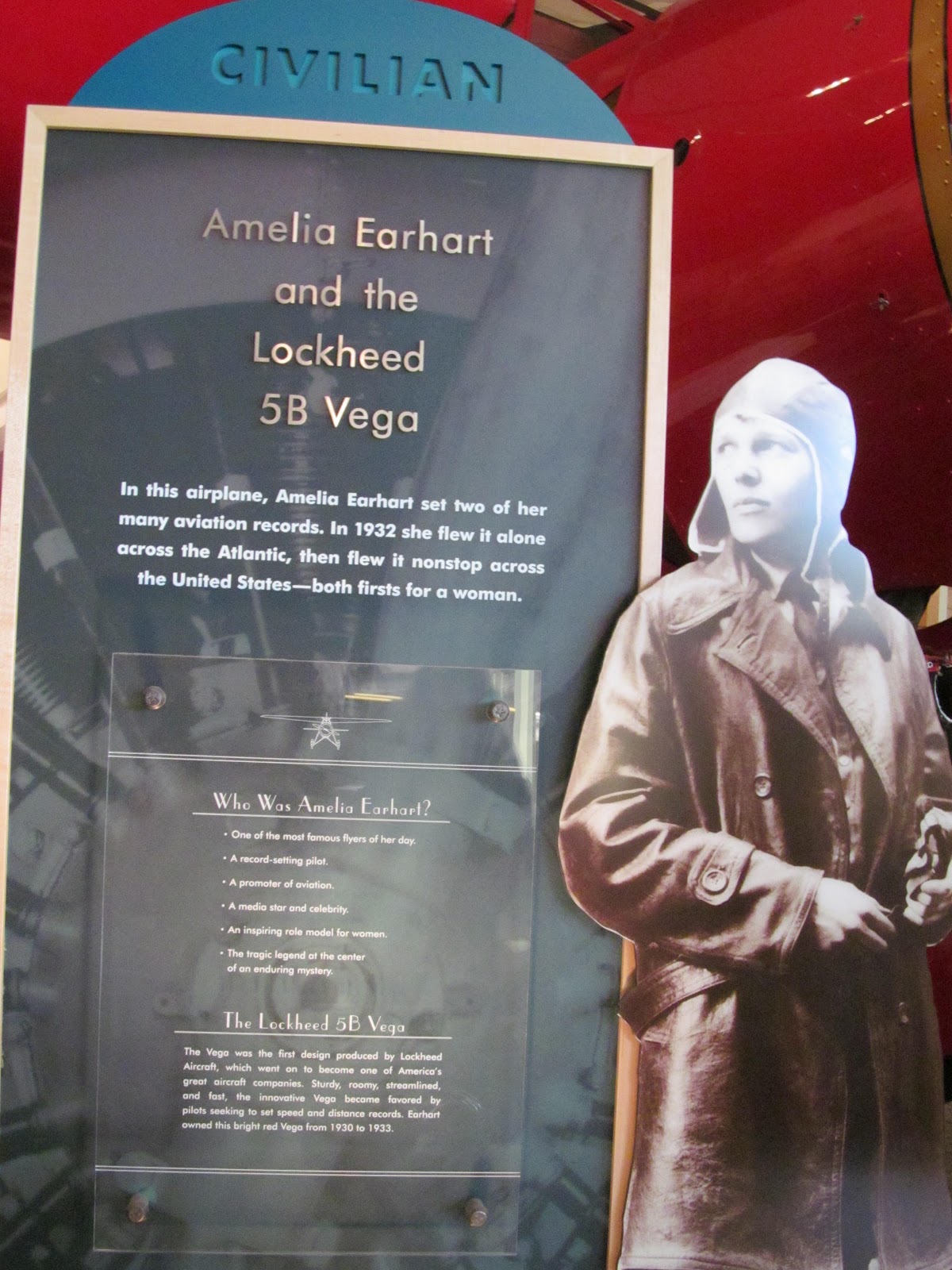
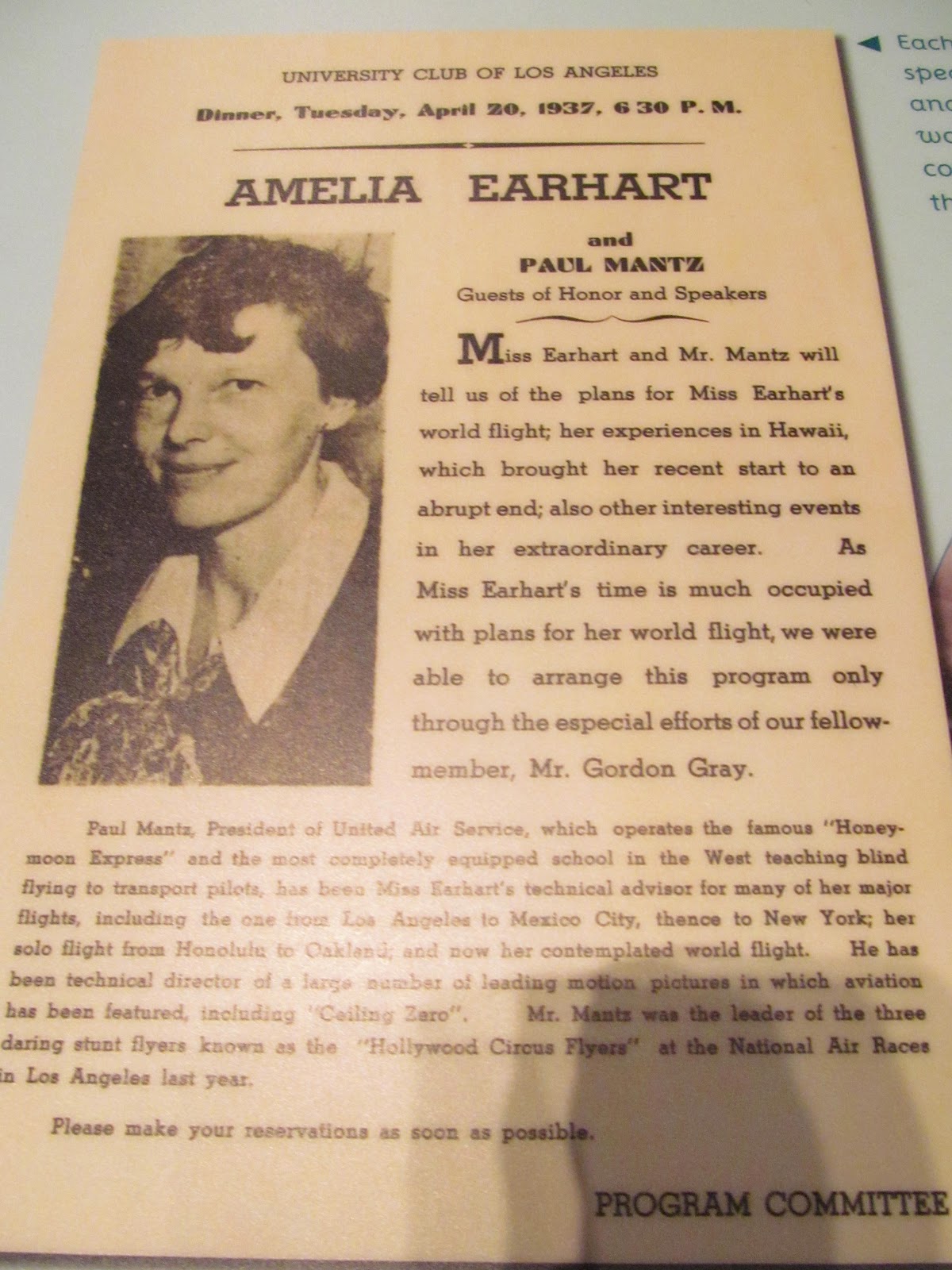
amelia earhart, i love you!
christina rozeas photography 2012
all rights reserved
air and space museum
washington, dc
~the globetrotting gamine
6.22.2012
6.18.2012
6.16.2012
4.20.2012
the whole truth.
see that photo?
please look at it clearly.
yes.
i did it :)
i published a book.
lookie- my name's there...
this is what i've been toiling over/relishing/going crazy over
since i've been back in the states.
i am so happy-
that this opportunity presented itself to me,
and that my love of writing/history/photography/
and piecing everything together
has bought this to pass.
so...yes.
just a na-na-na-na-poo-poo
to the people who fueled my fire
and pushed me to accomplish yet something else
that is freaking amazing.
and it's just the beginning :)
learn more about my signings, reading and events, here
and thank you so much
for your kind e-mails, comments, texts, and snail mail.
you
are
fantastic!!
warmest,
globetrotting gamine
over and out :)
10.15.2011
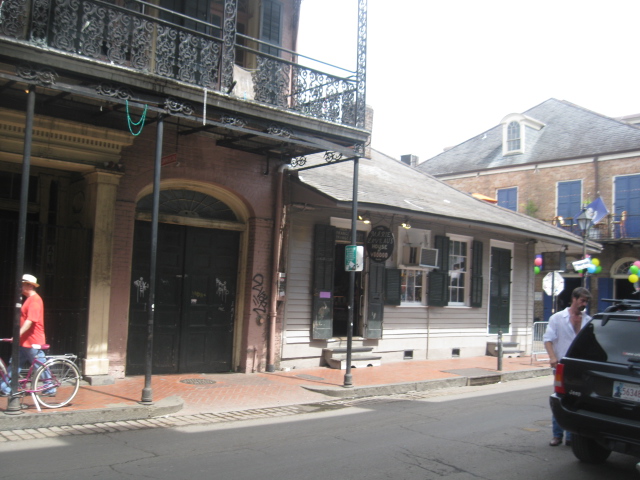
marie laveau
house of famed voo doo queen, marie laveau
taken from wikipedia:
Marie Laveau (September 10, 1794 – June 16, 1881) was a Louisiana Creole practitioner of Voudou renowned in New Orleans. She was born free in New Orleans.
Her daughter Marie Laveau II (1827 — c. 1895) also practiced Voudou, and accounts often confuse the two. She and her mother had great influence over their multiracial following. “In 1874 as many as twelve thousand spectators, both black and white, swarmed to the shores of Lake Pontchartrain to catch a glimpse of Marie Laveau II performing her legendary rites on St. John's Eve (June 23–24).”Marie I was believed to have been born free in the French Quarter of New Orleans, Louisiana, about 1794, the daughter of a white planter and a free Creole woman of color. On August 4, 1819, she married Jacques (or Santiago, in other records) Paris, a free person of color who had emigrated from Haiti.[1] Their marriage certificate is preserved in Saint Louis Cathedral in New Orleans. The marriage mass was performed by Father Antonio de Sedella, the Capuchin priest known as Pere Antoine.[2] Jacques Paris died in 1820 under unexplained circumstances. He was part of a large Haitian immigration to New Orleans in 1809 after the Haitian Revolution of 1804. New immigrants consisted of French-speaking white planters and thousands of slaves as well as free people of color. Those with African ancestry helped revive Voodoo and other African-based cultural practices in the New Orleans community, and the Creole of color community increased markedly.
[edit] CareerAfter Paris's death Marie Laveau became a hairdresser who catered to wealthy white families. She took a lover, Christophe (Louis Christophe Dumesnil de) Glapion, with whom she lived in a common-law marriage until his death in 1835. They were reported to have had 15 children including Marie Laveau II, born c. 1827, who sometimes used the surname "Paris" after her mother's first husband.[3]
Very little is known with any certainty about the life of Marie Laveau. Her surviving daughter had the same name and is called Marie Laveau II by some historians. Scholars believe that the mother was more powerful while the daughter arranged more elaborate public events (including inviting attendees to St. John's Eve rituals on Bayou St. John). They received varying amounts of financial support. It is not known which (if not both) had done more to establish the voodoo queen reputation.[4]
Of Laveau's magical career there is little that can be substantiated. She was said to have had a snake she named Zombi after an African god. Oral traditions suggested that the occult part of her magic mixed Roman Catholic beliefs, including saints, with African spirits and religious concepts. Some scholars believe that her feared magical powers of divination were actually based on her network of informants which she developed while working as a hairdresser in households of the prominent. As she visited her clients (mostly white) she listened closely to their gossip. Some assert that she ran her own brothel and cultivated informants in that way as well. She appeared to excel at obtaining inside information on her wealthy patrons by instilling fear in their servants whom she either paid or "cured" of mysterious ailments.[4]
On June 16, 1881 the New Orleans newspapers announced that Marie Laveau had been beheaded in the top tower of her own home. This is noteworthy if only because people claimed to have seen her in town after her supposed demise. Again, some claimed that one of her daughters also named Marie (many of the daughters had Marie within their names due to Catholic naming practices) assumed her name and carried on her magical practice, taking over as the queen soon before or after the first Marie's death.
According to official New Orleans vital records, a certain Marie Glapion Lavau died on June 15, 1881, aged 98.[5] The different spelling of the last name as well as the age at death may result from the casual 19th Century approach to spelling as well as conflicting accounts of Laveau's birth.
Marie Laveau was reportedly buried in Saint Louis Cemetery #1 in New Orleans in the Glapion family crypt (see External Links below for clickable tomb map.) This fact is in dispute, according to Robert Tallant, a journalist who has used her as a character in historical novels.[6] The tomb continues to attract visitors who draw three "x"s (XXX) on its side, in the hopes that Laveau's spirit will grant them a wish. Some self-styled researchers claim that Laveau is buried in other tombs, but they may be confusing the resting places of other voodoo priestesses of New Orleans.
Although some references to Marie Laveau in popular culture refer to her as a "witch", she is properly described as a 'Voodoo priestess'.
The French Quarter hotel The Historic French Market Inn has a bar named the 'Marie Laveau Lounge' on Decatur Street.
(above all taken from wikipedia- my story tomorrow!)
10.01.2011
The Witch House
I love the brochure of the Corwin House/Witch House that I picked up when in Salem.
Taken from there (www.salemweb.com/witchhouse)
"The Witch Trials"
in 1692, a wave of witchcraft accusations engulfed Salem and neighboring communities. As a local magistrate and civic leader, Corwin was called upon to investigate the claims of diabolical activity. He and JOhn Hathorne performed a number of the initial examinations of accused withces. Corwin also served on the Court of Oyer and Terminer, which ultimately sent nineteen to the gallows. All maintained teir innocence until their deaths.
"About the Museum"
The house remained in the Corwin family until the mid-1800s. Later, an apothecary opened up a shop on the first floor, expanding the house once again. In 1944, the threatened destruction of the Witch House inspired anew wave of restoration in Salem. Concerned citizens raise $42500 to move and restore the building. The museum officially opened to the public in 1948.
i love it.
love me,
the globetrotting gamine
1.12.2011
my family tree
that's my great-grandfather
i never met him,
but i'm pretty sure since we're related
that he's holiding a huge bowl of pasta with meat sauce
and sprinkling it with sauce on top :)
he travelled around the world.
this is my great aunt evdoxia...
she was everyone's favorite aunt
(especially my mom's: they used to stay up late when my mom was bitty
and watch the corny old black and white horror movies-
which were not corny or old back then)
i'm pretty sure she was my great-great aunt from my grandma's dad's side.
i heard she was a famed storyteller.
guess that's where i get that from.
the girl to your left? that's my grandmother
i lived with her until i got married and moved on out,
and she lived with my parents until she needed to
go to a rehab center by my house.
isn't she cute?
that bitty baby to the right of the pic
is her brother, Jerry.
my grandma was a massive homebody
the complete package as a housewife and
the matron of the family.
my grandmother eventually married this guy.
that's my grandfather, on a ship.
another member of my family who travelled around the world
any and every way he knew how.
so cool.
he was an artist, a photographer...
so creative.
he would have flipped
with the thoughts of internet,
photoshop,
and digital cameras.
i don't imagine he'd be that different from me.
i was named after him.
that bitty baby there?
that's my mama.
i think she took off her shoe in this pic.
uber-mischievous...
she used to make fun of the ladies
that used to go over and visit my Grandmother and Great Grandmother,
wreak havoc by running away,
and saved her cat that was about to get abused to death...
all before she hopped on the boat to ellis island.
she's got stories out the whazoo.
(like me!)
never could sit still.
(i can)
and knits, makes the best tea
and gives the best hugs.
that's my family in their manhattan apartment. Grandma is holding a cat.
they loved cats.
shots of my family hanging out at cafes and
tavernas with each other and friends.
that's my Daddy in that bottom shot there.
quite an adventurous bunch of people...
and the apple doesn't fall far from the family tree
1.10.2011
mystery of the vasilopita
welcome
to the mystery of the vasilopita post.
i'm greek. 100%, as LML is.
our parents are 100%.
what happened ancestreally, before them-
Egypt has been mentioned
but moving on...
have you been paying attention? KIDDING!
So to wiki-sum it up:
what is a vasilopita?
wikipedia definition:
On New Year's Day families cut the vasilopita to bless the house and bring good luck for the new year. This is usually done at the midnight of New Year's Eve. A coin is hidden in the bread by slipping it into the dough before baking. At midnight the sign of the cross is etched with a knife across the cake. A piece of cake is sliced for each member of the family and any visitors present at the time, by order of age from eldest to youngest. Slices are also cut for various symbolicall people or groups, depending on local and family tradition. They may include the Lord, St. Basil and other saints, the poor, the household, or the Kallikantzaroi. In older times, the coin often was a valuable one, such as a gold sovereign. Nowadays there is often a prearranged gift, money, or otherwise, to be given to the coin recipient.
Many private or public institutions, such as societies, clubs, workplaces, companies, etc, cut their vasilopita at a convenient time between New Year's Day and the beginning of the Great Lent, in celebrations that range from impromptu potluck gatherings to formal receptions or balls.
Saint Basil's Feast Day is observed on January 1, the beginning of the New Year and the Epiphany season known as the Vasilopita Observance.
the question remains: WHAT HAPPENED WITH OUR VASILOPITA?
so my Father picks up the Vasilopita a day in advance every year. His nameday (and my nephew's nameday, is on New Years Day)
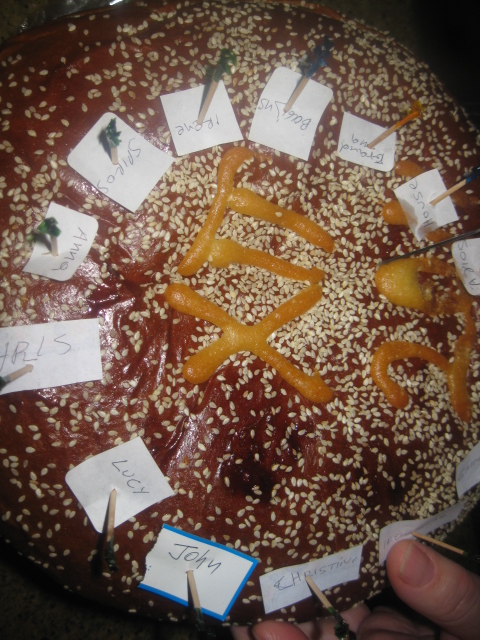
Daddy gets very organized. He writes everyones name on a strip of paper, grabs some toothpicks, and arranges everything around the vasilopita. We're supposed to cut a piece for each member of the family, the house, the Saint and God.
Whoever gets the lucky coin, which is wrapped in foil carefully and baked into the pie before buying it- is lucky the entire year of the entire family.
If it's the house, God, Saints, it's all good.
if it falls to the youngest members of the family, still good.
But this year?
No one got it. No ONE.
It was not there.
Unless, I eated it?
Would you go back and complain?
LML's suggestion: let's just say I won :)
I love him :)
love me,
the globetrotting gamine
10.04.2010
I love Greenport
(all photos taken by me, The Globetrotting Gamine 2010)
Excerpt from one of my favorite sites (not by me!):
"The History of Greenport, LI
East of Manhattan, beyond some of the world's most renowned vineyards and at the edge of Long Island's vast farmlands, you will find yourself at the end of the earth, immersed in one of the hottest spots on the East Coast -- Greenport. This small seaside village has become famous for its quaint retail establishments, fine dining, and nightlife like no other, but what makes Greenport so unique is its rich maritime history, which has been tastefully preserved for more than three centuries.
First settled in 1682, Greenport was originally comprised of two settlements. Stirling, located on the West side of Stirling Basin on the North edge of what is now Greenport, ran along King's Highway (now known as Route 48 or North Road) and faced the Long Island Sound. The other, named Green Hill, overlooked the harbor. As the two settlements flourished the residents of Stirling and Green Hill officially merged the two and, in 1831, officially adopted the name Greenport. In 1838, it became the second incorporated village in the State of New York.
In the years that followed, Greenport became a prominent whaling port and, at the height of the whaling boom, the Long Island railroad was extended to village, making it the main link in the rail-steamboat route between New York and Boston. By 1856, Greenport boasted 250 homes, 16 stores and 3 shipyards. As the whaling industry faded, commercial fishing increased, keeping the local boat yards in business. During Prohibition, rumrunners became active off Greenport and a Coast Guard station eventually opened in the village. Local shipyards further profited, doing business for both the good guys and the bad. To catch a glimpse of Greenport's past, make sure that the East End Seaport Museum, Bootleg Alley, and some of the villages remaining shipyards are on your "to do" list.
It's not just the maritime industry, however, that helped put this village on the map. Historically, Greenport has also been attractive to some of America's most renowned artists including Walt Whitman; playwright William Gillette; painter Whitney Hubbard; and author & illustrator Marjorie Flack. Many of their homes, or the homes of those who connected them to the village, still stand today. Visitors can spend an entire day just exploring the historic homes of Greenport.
Today, artists continue to find a home in Greenport, including award-winning actress Peg Murray; sculptor Arden Scott; craftsperson Gail Horton and award winning songwriter Hugh Prestwood. With outdoor theater, live music events, and a plethora of galleries, the arts are still very much alive in the Village of Greenport.
Most recently, the Village of Greenport has upped the ante on fun with the creation of the expansive Mitchell Park, which overlooks Greenport Harbor. Although some of the park is still under construction, the outdoor amphitheater, harbor side boardwalk and public docks are quite active during the busy summer months. The icing on the cake, however, is Greenport's famous carousel. Built in the 1920s as a carnival ride in North Tonawanda, New York, the 40-foot carousel was donated to the village of Greenport in 1995 by Northrop-Grumman. Greenport boasts a population of just over 2,000 and, although the village seemingly bursts at the seams when thousands more visitors descend during the tourist season, there is plenty of room for everyone. To get an extra dose of Greenport's arts and culture, ring in the New Year during the village's annual First Night festival or celebrate its rich nautical history, during the village's annual Maritime Festival, which takes place each September. Nevertheless, no matter what time of year you visit, you will find a warm welcome in Greenport and, we are sure, you will have a great time! "
The pictures I've posted are from the Greenport Jail, now a museum. I didn't know this, but i looked it up and http://www.greenportvillage.com/activities.html said this:
"Greenport Jail and Police Museum
1917 Jail featuring memorabilia, pictures andhistoric items from the Greenport Police Department including photos, patchs and items of other police forces in the U.S."
It's just awesome
and you should visit!
love me,
the globetrotting gamine <3
Subscribe to:
Posts (Atom)